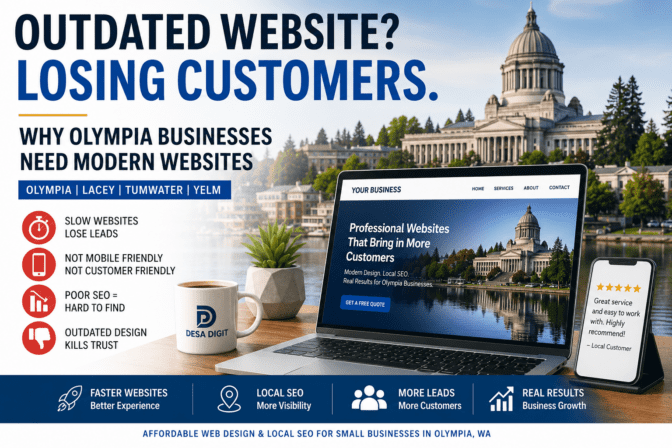


Why Your Small Business Isn’t Getting Leads (And How to Fix It)
If your website is not generating leads, the problem is not random—it is structural. In 2026, small businesses in Olympia, Seattle, and across Washington are competing in a digital-first environment where customers expect clarity, speed, and trust instantly.
According to HubSpot, businesses that optimize conversion pathways see significantly higher lead generation. That means the difference between a website that “exists” and one that produces results often comes down to a few critical elements being either present—or missing.
Quick Answer: Why You’re Not Getting Leads
- No clear call-to-action (CTA)
- Weak or missing SEO visibility
- Slow website performance
- Lack of trust signals
- Poor mobile experience
- Confusing messaging
Why Lead Generation Fails for Most Small Businesses
Most websites fail to generate leads because they do not guide users toward action. Visitors arrive, browse briefly, and leave without understanding what to do next.
This is especially common in local markets like Olympia and Seattle, where customers are comparing multiple businesses quickly. If your site does not stand out immediately, you lose the opportunity.
For a deeper breakdown of these issues, see: 10 Small Business Website Mistakes That Cost You Customers .
1. No Clear Call-to-Action (CTA)
If your website does not clearly tell users what to do next, they will leave—even if they are interested.
Strong CTAs include:
- Get a Free Quote
- Call Now
- Schedule a Consultation
Your CTA should be visible immediately and repeated throughout the page.
2. Poor SEO = No Visibility
If people cannot find your website, they cannot become leads. SEO is what connects your business to customers actively searching for your services.
Google emphasizes helpful content and clear structure as key ranking factors. Without these, your site struggles to appear in search results.
Learn more in: why your website matters .
3. Slow Website Performance
Speed directly affects both user experience and conversions. Slow websites cause visitors to leave before engaging.
Google performance research shows that faster sites retain more users and generate better results.
See our full breakdown here: speed and performance issues .
4. Lack of Trust Signals
Trust is a major factor in whether someone becomes a lead. Without it, users hesitate or leave.
Trust signals include:
- Customer reviews
- Testimonials
- Real photos
- Clear contact information
Strong trust signals make your business feel credible and reliable.
5. Poor Mobile Experience
Most local traffic comes from mobile devices. If your site is hard to use on a phone, you lose leads immediately.
Mobile-friendly design is also a ranking factor in Google’s search algorithm.
6. Confusing or Weak Messaging
If users do not understand what you do, they will not contact you. Clear messaging is essential.
Your homepage should answer:
- What do you offer?
- Who do you help?
- Why choose you?
Strong messaging improves both conversions and SEO.
How to Turn Your Website Into a Lead Machine
To consistently generate leads, your website must combine:
- Clear messaging
- Strong SEO
- Fast performance
- High trust
- Simple user flow
When these elements work together, your website becomes a system—not just a page.
Conclusion
If your small business is not getting leads, the issue is fixable. By improving clarity, trust, speed, and SEO, you can transform your website into a powerful lead-generation tool.
In 2026, the businesses that win are not just visible—they are clear, fast, and easy to trust.
Frequently Asked Questions
Why is my website getting traffic but no leads?
This usually means your conversion system is weak—poor CTAs, low trust, or unclear messaging.
What is the fastest way to increase leads?
Improve your CTA placement, add testimonials, and simplify your layout.
Does SEO affect leads?
Yes. SEO brings the right visitors to your site, increasing your chances of conversions.